Menopause and Constipation: How Aging and Muscle Loss Affect Your Gut and Pelvic Floor
Welcome to your Weekly Digest(ive)!

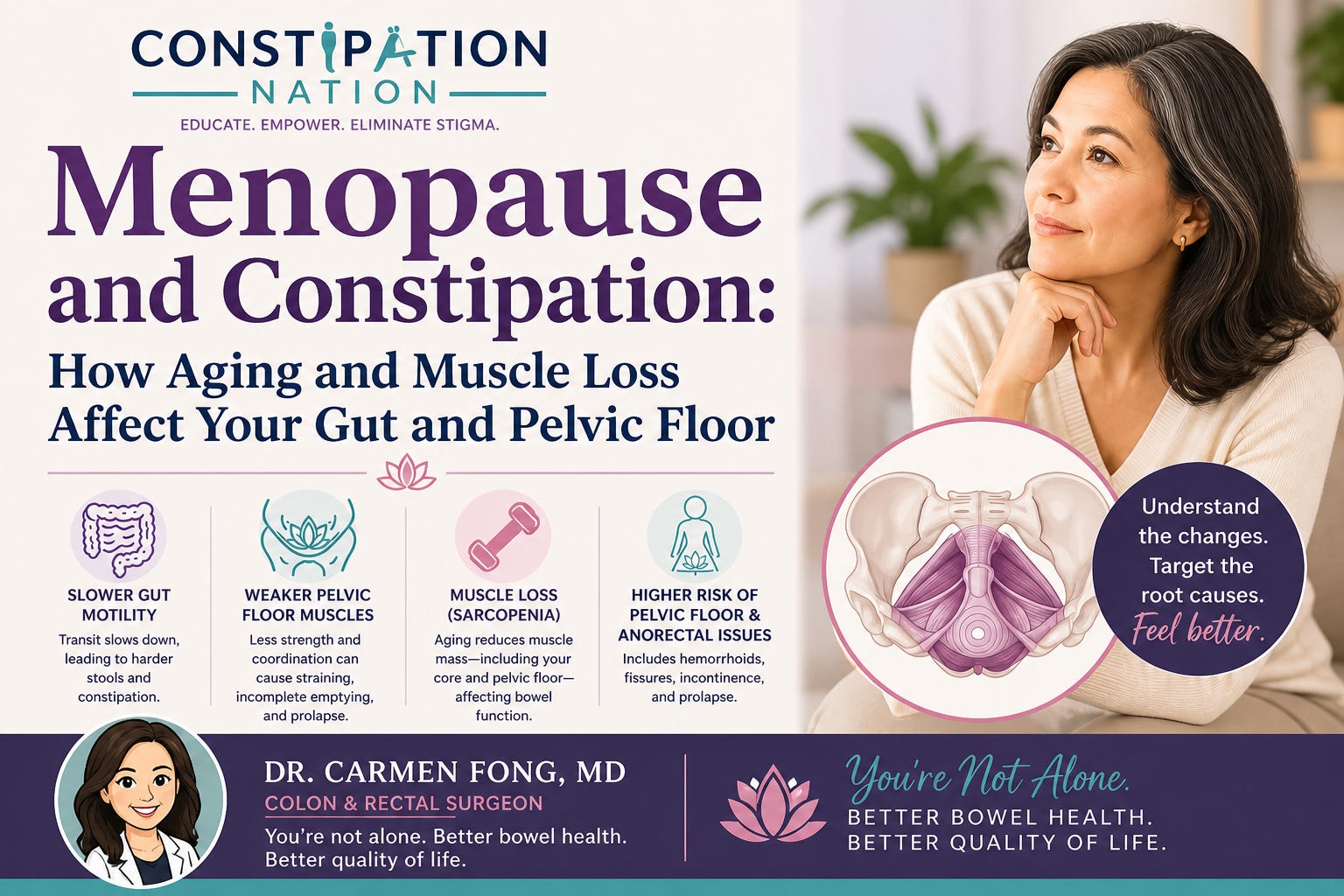
What Happens to Your Gut, Pelvic Floor, and Anorectal Health Over Time?
If you’re an elder millennial like me, you might just be hitting this new phase of life– perimenopause. About a year ago, my period suddenly went from its usual 3-to-5-day length to two weeks. Half the month. I am terrible about going to the doctor, but bleeding for two weeks is never normal. So I went in. Had an ultrasound, which cost like $800 even with insurance (crazy). Blood work. None of it showed anything nefarious, so my ob/gyn, whom I appreciate as much as I can appreciate any healthcare provider, concluded: It’s probably perimenopause. The next month, my period went back to normal. But it has me thinking, and it’s in all the news- menopause is often framed as a hormonal transition—but it is also a musculoskeletal and gastrointestinal transition.
As estrogen levels decline, changes occur not just in mood, metabolism, and bone health, but in muscle mass, connective tissue, and gut function. These changes can have a profound effect on bowel habits and the incidence of anorectal conditions.
For many patients, this is the moment when:
Constipation worsens
Pelvic pressure develops
Hemorrhoids flare
New symptoms appear that “weren’t a problem before”
And yet, this connection is rarely explained clearly.
The Physiology: Estrogen, Muscle, and the Gut
Estrogen plays a role in multiple systems that influence gastrointestinal function.
It helps maintain:
Smooth muscle function in the gut
Collagen and connective tissue integrity
Pelvic floor muscle tone and coordination
Gut microbiome balance
With menopause, declining estrogen contributes to:
Reduced gut motility
Increased transit time
Changes in stool consistency
Altered microbial composition
At the same time, aging itself is associated with sarcopenia, or loss of skeletal muscle mass and strength—including the muscles of the pelvic floor.
Sarcopenia and the Pelvic Floor
Muscle loss does not just affect arms and legs.
It affects the pelvic floor, which plays a central role in:
Bowel movements
Continence
Support of pelvic organs
As muscle strength declines, patients may experience:
Incomplete evacuation
Straining
Fecal incontinence
Pelvic organ prolapse
In some patients, this presents as worsening constipation. In others, it presents as loss of control.
Effects on Gastrointestinal Function
Aging and menopause influence the gut in several key ways.
Slower Transit
Colonic motility tends to decrease with age, leading to:
More time for water absorption
Harder stools
Increased constipation
Increased Sensitivity
Some patients develop symptoms resembling IBS, including:
Bloating
Abdominal discomfort
Irregular bowel patterns
Microbiome Changes
Hormonal shifts can alter gut bacteria, which may influence:
Inflammation
Motility
Gas production
Incidence of Anorectal Conditions
With these physiologic changes, several anorectal conditions become more common.
Hemorrhoids
Chronic straining and constipation increase venous pressure, leading to:
Symptomatic hemorrhoids
Bleeding
Prolapse
Anal Fissures
Hard stools and increased sphincter tone can contribute to:
Painful tears
Bleeding with bowel movements
Pelvic Organ Prolapse
Weakened connective tissue and muscle support can lead to:
Rectocele
Rectal prolapse
Sensation of vaginal or rectal bulging
Fecal Incontinence
Loss of muscle strength and nerve function may cause:
Leakage
Urgency
Difficulty controlling gas
Why Symptoms Often Worsen After Menopause
Many patients report that their bowel habits change “suddenly” around menopause.
This is not coincidence.
It reflects the combined effects of:
Hormonal decline
Muscle loss
Changes in tissue elasticity
Altered gut function
What Actually Helps
While these changes are common, they are not inevitable or untreatable.
Strength and Muscle Preservation
Resistance training
Pelvic floor physical therapy
Core strengthening
Bowel Optimization
Adequate hydration
Targeted fiber (often soluble fiber)
Osmotic agents when needed
Pelvic Floor Evaluation
For symptoms of:
Incomplete evacuation
Prolapse
Incontinence
Early evaluation can prevent progression.
Hormonal Considerations
In some patients, hormone therapy may play a role in symptom management, particularly for genitourinary symptoms, though its role in GI function is still being studied.
The Bottom Line
Menopause is not just a hormonal event—it is a functional shift across multiple systems, including the gut and pelvic floor.
Constipation, pelvic symptoms, and anorectal conditions after menopause are common—but they are not something you have to simply accept.
Understanding the underlying physiology allows for targeted, effective treatment.
Because it’s National Pelvic Pain Month, my friend and colleague Dr. Robin Ellis has written several blog posts on pelvic floor function, which we will cross-post every Friday!
Until next time, that’s just the way the anus wrinkles.